

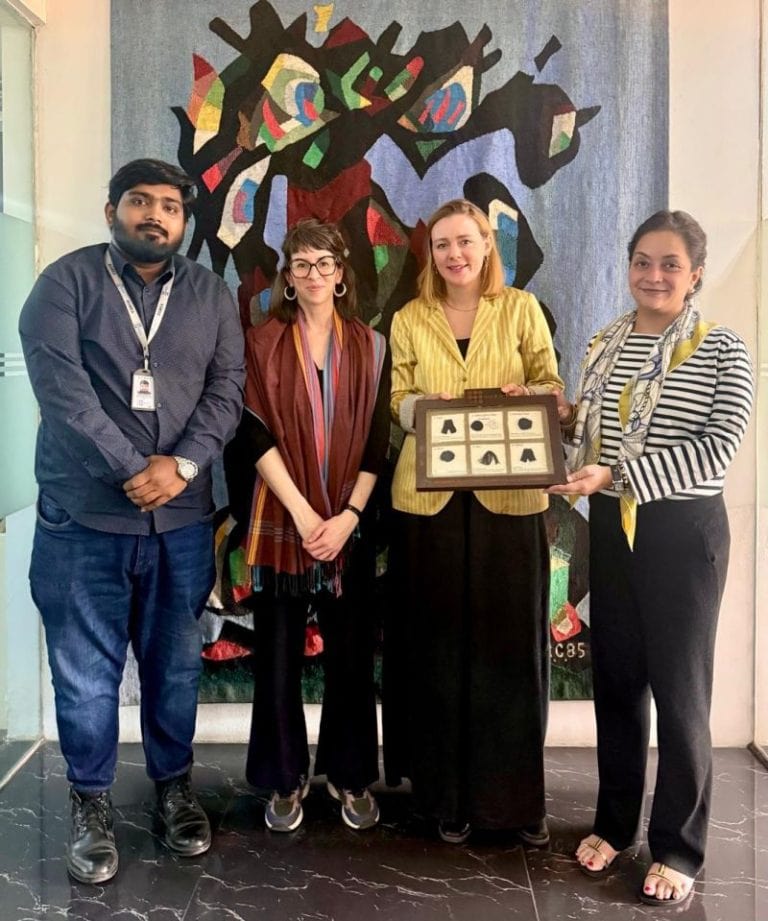
On 21 April, Closed Loop Fashion (CLF) met with the Bangladesh Garment Manufacturers and Exporters Association (BGMEA) in Dhaka, represented by Vice President Ms. Vidiya Amrit Khan and Secretary Mr. Syed Ahmed Ali, to discuss how circularity can be advanced across Bangladesh’s textile industry. As one of the country’s leading garment and apparel export associations, BGMEA plays a key role in scaling solutions for textile waste and recycling.
The discussion focused on current developments on the ground and identified gaps in advancing circularity further. BGMEA shared updates from recent initiatives, including policy advocacy and their involvement in the United Nations Industrial Development Organization (UNIDO) project in collaboration with Bestseller, as well as other ongoing efforts. While progress is evident, a key challenge remains around access to textile waste and its effective utilization and processing.
One of the key issues raised was the limited capacity to retain textile waste within the country, as a significant amount is currently exported to India. Despite the large volumes generated, this outflow reduces the opportunity to build local recycling capacity and capture value within Bangladesh’s existing textile industry.
The discussion highlighted the realities of waste flows in Bangladesh, where textile scraps ‘jhut’ are primarily managed through well-established but largely informal systems. These operate via hierarchical networks of collectors, aggregators, and traders, often described as ‘muscle groups’, who play a central role in handling and redistributing material from factories onwards.
While these systems are efficient and provide livelihoods for many small and medium-sized enterprises, limited regulatory oversight results in unclear ownership, traceability, and final destinations of textile waste, with significant volumes also entering export streams. This limits opportunities to retain material value domestically and to develop more structured circular systems.
Building on its experience across markets in Asia and Africa, CLF shared key enablers for closed-loop systems, including stronger and standardized collection and sorting infrastructure, improved traceability mechanisms, stakeholder alignment, and supportive policy frameworks and investments. The CLF team also shared some positive examples from other country’s approaches and how challenges had been addressed.
With upcoming EU requirements under the Ecodesign for Sustainable Products Regulation (ESPR), the Digital Product Passport (DPP), and the Waste Framework Directive (WFD), demand for traceability and recycled content is expected to rise significantly. For Bangladesh, as a key supplier to European markets, this marks a critical point to move beyond pilots towards systemic change. A recent Chatham House study also indicates that these evolving circularity requirements may reshape trade flows between Bangladesh and the EU over time.
The meeting concluded with a shared understanding that circularity is not only about reducing environmental impact, but also about strengthening the long-term resilience and competitiveness of Bangladesh’s textile sector in a changing global market.
