

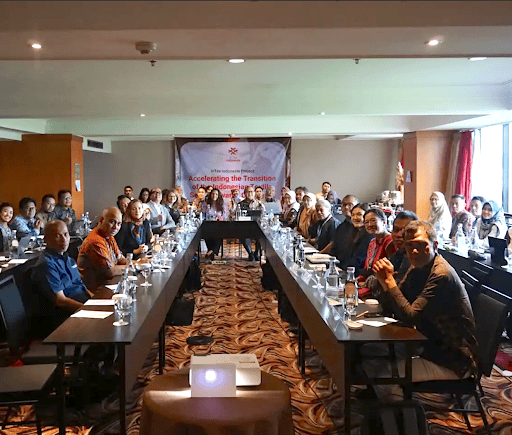
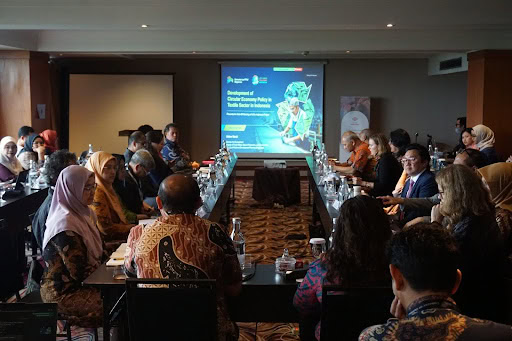
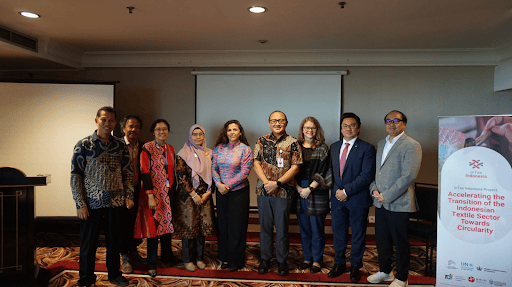
The United Nations Environment Programme (UNEP) officially launched the InTex Programme in Indonesia on 5 November 2025 during a national event in Jakarta, co-hosted with the Ministry of National Development Planning (Bappenas).
The launch marks a key milestone for Indonesia’s textile and apparel sector, reinforcing national efforts to transition toward a more circular economy in line with the Circular Economy Roadmap and Action Plan. As one of the world’s major textile manufacturing hubs, Indonesia plays a critical role in shaping how circularity can be embedded into policy and then translated into practice at scale.
InTex Indonesia is designed to support this transition by working closely with government institutions, industry associations and, in particular, small and medium-sized enterprises across key textile regions. The programme will support companies in applying Life Cycle Assessment (LCA) tools and approaches, improving resource efficiency and competitiveness, and testing circular business models that respond to local realities. A central focus of the project is also the development of Indonesia-specific life-cycle data, providing a stronger evidence base for policy making and creating clearer incentives for circular solutions to scale.
For many manufacturers, especially SMEs, limited access to data, tools and technical support has been a longstanding barrier to adopting circular practices. By combining applied LCA methodologies with industry engagement and policy alignment, the InTex Programme aims to bridge this gap and enable more informed decision-making across the textile value chain in Indonesia.
During the preparatory phase of the InTex Programme, Closed Loop Fashion has been in regular exchange with UNEP, contributing on-the-ground insights drawn from our work across Indonesia’s textile and apparel sector. These exchanges were informed by our development cooperation efforts with SMEs and focused on practical challenges and opportunities for advancing circularity in practice. In parallel, potential collaboration activities were discussed and synergies identified to enable continued dialogue and the structured exchange of key findings as the programme moves forward.
The InTex Programme adds an important layer of systemic support to Indonesia’s circular economy landscape and complements ongoing efforts by industry actors, government and civil society to build more resilient and resource-efficient textile supply chains. We look forward to following the progress of InTex Indonesia and to continued collaboration across the ecosystem to support a just and scalable transition toward circularity!
Funded by the Government of Denmark, the programme will be implemented together with the Resilience Development Initiative (RDI), in collaboration with the National Research and Innovation Agency (BRIN) and James Cook University.
